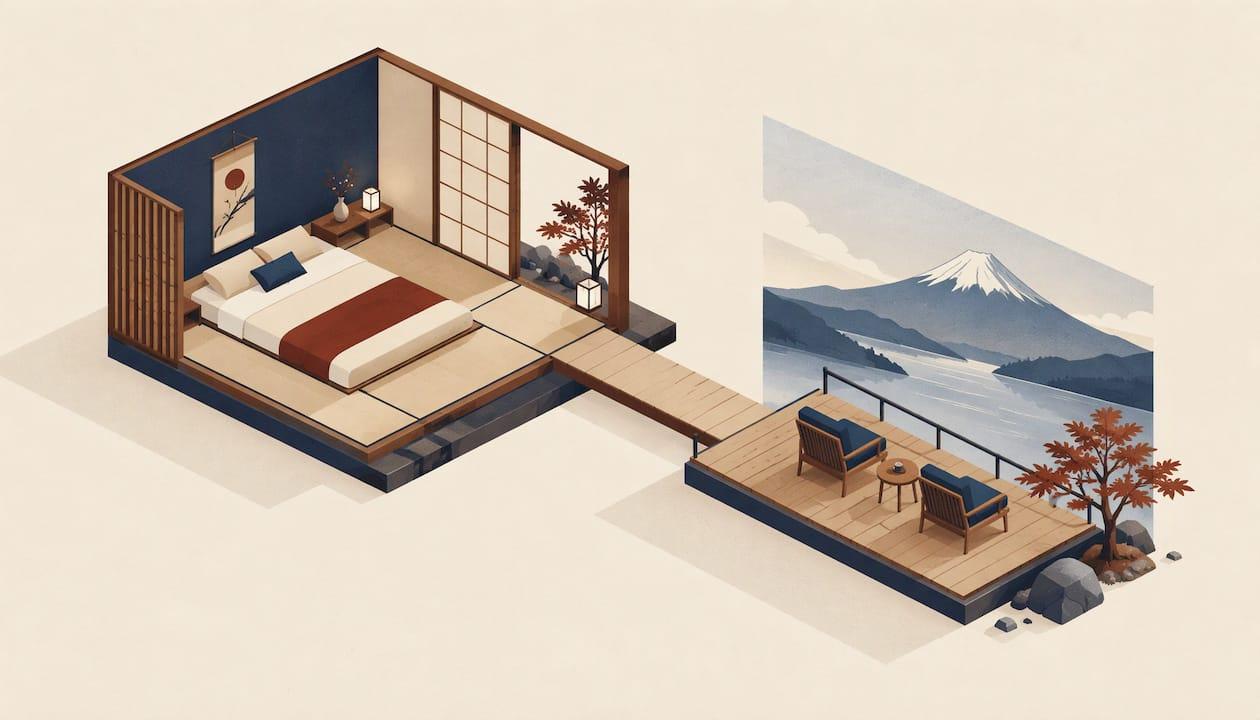
The best way to get a Mount Fuji view from a ryokan is to stay on the north side of the mountain, around Lake Kawaguchi in Fujikawaguchiko, and to book a specific room, not just the inn. Many ryokans there advertise Fuji, but the view often depends on which side of the building your room faces. Pick the room, check the bath and meal details, and you have the stay you imagined.
This guide is for travelers who want the full experience: tatami floors, a hot spring bath, a multi-course dinner and Fuji in the window. It covers where to go, what to look for in a room listing, how weather changes the picture, and what a stay costs and includes.
TL;DR
- Lake Kawaguchi (Fujikawaguchiko) is the most popular base for ryokans with Fuji views, with inns such as Ubuya, Konansou and Kukuna named in Japan Airlines' guide to Fuji-view stays.
- Book a room, not a property. At some inns every room faces Fuji, at others only designated rooms do, and even those can be clouded over.
- Ryokan prices are per person and normally include dinner and breakfast, so compare the per-person rate with meals included.
- Couples should look for a private open-air bath on the room's own terrace. Families should check maximum room capacity first.
- Cannot get a room? Some ryokans rent out a private Fuji-view bath by the hour, but not all accept day visitors.
Table of Contents
- Where to stay for a Fuji view
- Not every room has the view
- The weather reality
- What a Fuji-view ryokan stay includes
- Choosing for couples
- Choosing for families
- What does it cost?
- No room? A Fuji-view bath without staying overnight
- How to book a Fuji-view ryokan, step by step
- Book a Fuji-view ryokan with Ryokan Society
- FAQ
- Sources
Where to stay for a Fuji view
Mount Fuji sits on the border of Yamanashi and Shizuoka prefectures, and the postcard views come from several directions. For a ryokan stay, the easiest and most reliable area is the Lake Kawaguchi shoreline on the north side. The lake gives you a foreground of water, hot spring towns have developed around it, and the mountain rises directly across it.
There are alternatives. Lake Shoji and the Hakone area also have inns with Fuji outlooks, and some travelers combine them into a longer route. But if this is your first Fuji ryokan and you have only one or two nights, Kawaguchiko is the practical choice because the density of inns means you can compare rooms, baths and meals in one place. Our Kawaguchiko ryokan and onsen page lists inns in this area with their baths, meals and prices, and the Mt. Fuji ryokan page groups stays by their private onsen rooms.

Getting there
Most travelers reach Lake Kawaguchi from Tokyo by train and bus, and the stay itself is easy to build around Kawaguchiko Station. According to Japan Airlines' guide, Ubuya is about a five-minute drive from the station, and many inns offer pickup. Check pickup times when you book, because the last arrivals and meal times at a ryokan are fixed, and a late arrival can mean a missed dinner.
Not every room has the view
This is the part most guides skip. A ryokan can be famous for Fuji and still give you a room that looks at a parking lot.
There are three cases to understand.
- Every room faces Fuji. Ubuya's official guest-room page says all of its rooms face both Mount Fuji and Lake Kawaguchi, so any room type gets you the view. Ubuya's room list runs from Japanese-style rooms to suites.
- Some rooms face Fuji. Japan Airlines' guide says Konansou's view depends on which side of the building you book. Konansou's own English site lists ten Mount Fuji-view rooms, each with a private open-air bath, with a capacity of up to four guests.
- A few designated rooms guarantee the view. Gora Kadan Fuji's official FAQ says only its detached Villa Hare, Rooftop and Type A rooms are designated to guarantee a Fuji view.
So the first rule is simple: look for the words "Fuji view" in the room name or description, not just in the property's marketing. On Ryokan Society you can filter by bath and room features and read the room-level details in English before choosing a rate, which saves you from guessing from a hero photo.
The weather reality
A guaranteed view room is a guarantee about direction, not about clouds. The same Gora Kadan Fuji FAQ notes that visibility varies with weather, season and time of day, even from its designated rooms.
What that means in practice:
- Mornings are your best chance. Fuji is more often clear early in the day, and the same FAQ points to time of day as a factor. Plan to wake early with the curtains open.
- Build in a second night. Two nights give you two chances at a clear sky, and a relaxed ryokan stay is better with a full free day in between.
- Choose a room where the view includes the bath. If clouds hide the summit during the day, a private open-air bath still gives you the lake, the garden and the atmosphere. A bath facing Fuji turns an overcast afternoon into part of the experience.
- Treat the view as a bonus on top of the stay. Konansou's official site presents the stay as a package: private and shared baths, a rooftop footbath and seasonal meals. That is the right way to judge any Fuji ryokan.
What a Fuji-view ryokan stay includes
If you have never stayed in a ryokan, the format is part of the appeal. Here is what to expect, using details the inns themselves publish.
Rooms
Traditional rooms have tatami mat floors, and futons are laid out for sleeping in the evening while you are at dinner or in the bath. Many Fuji-area inns also offer rooms with beds for guests who prefer them. Ubuya, for example, lists suites with twin beds and private open-air baths alongside Japanese-style rooms.

Baths
The onsen, or hot spring bath, is central. You will usually find a choice of large shared baths and, in higher-category rooms, a private bath attached to the room. Konansou's official site lists large public baths, a Fuji-view private bath and a rooftop footbath, alongside its rooms with private open-air baths. At Hakkai Konohanakan, the official site says its private volcanic hot-spring baths are available 24 hours, so you can soak at midnight or at dawn.
If you are new to onsen etiquette: you wash and rinse thoroughly at the washing station before entering the shared bath, and you enter without a swimsuit. A private bath removes that concern entirely, which is why many couples and first-time visitors choose it. Our private onsen rooms page collects ryokans that offer a bath in or attached to the room.
Meals
Dinner is a seasonal multi-course meal called kaiseki, and breakfast is traditionally Japanese. Konansou's site lists a seasonal kaiseki dinner and a buffet breakfast, and Hakkai Konohanakan describes kaiseki prepared with seasonal ingredients. The Japan Ryokan Association explains that a ryokan stay is priced as one night with two meals: dinner on arrival and breakfast the next morning, usually served in the guest room, known as heya-shoku. That is why the rate you see already includes food.
Choosing for couples
For a romantic stay, three things matter more than the star rating.

A private open-air bath in the room. Konansou lists ten Mount Fuji-view rooms, each with a private open-air bath. Hakkai Konohanakan describes five premium rooms, each with a private entrance, semi-open-air hot-spring bath and Japanese garden. These layouts let you bathe together with no schedule and no shared spaces.
Dinner served in your room. Room dining, which the Japan Ryokan Association describes as the usual ryokan practice, keeps the evening unhurried. When you compare listings, check whether dinner is in the room or in a dining hall.
A view from the bath, not just the bed. Read the room description for terrace or bath orientation. A room can face the lake and still have its bath facing a wall.
Browse these options through our private onsen room listings, where you can filter for the room features you care about.
Choosing for families
A ryokan can be an excellent first cultural experience for children, who tend to enjoy the futons, the yukata robes and the dinner presented in small dishes. A few practical points make the stay smoother.
- Check capacity before anything else. Ubuya lists rooms for two to six guests, including a 113 square meter Special Suite 501 for two to six. Its Japanese-style rooms accommodate two to six or two to four guests. Konansou's Fuji-view private bath rooms hold up to four.
- Ask about children's meals. Kaiseki is a long meal. Check whether the rate you book allows meal adjustments for younger guests, and read the guest policies on the property page.
- Pick a room with its own bath. A private bath lets everyone soak together, which is simpler for families than shared baths that are split by gender.
- Choose a larger tatami room over several small rooms. Sleeping together on futons is part of the experience.
The room and policy details on each Ryokan Society listing are in English so you can confirm capacity and guest rules ahead of time.
What does it cost?
Ryokan pricing surprises first-time visitors in two ways. First, the rate is per person, not per room. Second, it includes dinner and breakfast.
The Japan Ryokan Association states that average prices across its member ryokans range from ¥5,000 to ¥119,000 per person. That is a very wide range, and a Fuji-view room with a private bath sits toward the upper part of it because you are paying for the room category and a multi-course dinner as well as the view.
When you compare listings, use this checklist:
- Per-person rate and number of guests. A rate for two people means double the figure you first see.
- Meals included. Dinner and breakfast are standard. Confirm any upgrade for a richer kaiseki menu.
- Room category. A standard Fuji-side room, a room with a private bath and a suite are priced very differently.
- Day of the week and season. Weekends, autumn foliage, cherry blossom time and the clear winter weeks are in high demand around Fuji.
- Cancellation terms. Review these on the rate you select.
Because prices change by season and room, use the live availability on the property page for dates, not a figure from a blog post.
No room? A Fuji-view bath without staying overnight
Some travelers who cannot book a night still want the bath. Policies differ by inn. Konansou's Q&A page says it does not accept day visitors for bathing, but it offers a chartered bath for ¥3,300 for 50 minutes, with reservations taken at the front desk during set hours in the afternoon and evening and in the early morning. Japan Airlines' guide, published in 2022, says Kukuna has public onsen facing Fuji and a reservable private onsen. That price was stated in 2022, so confirm it before you plan around it.
The lesson is that day-use rules are inn-specific. If the view and the bath are the point of your trip, a night's stay is still the surest way to get both, with dinner and a quiet morning included.
How to book a Fuji-view ryokan, step by step
- Choose the base. For a first trip, Lake Kawaguchi. Use our Kawaguchiko page to see the inns in one place.
- Set your dates with flexibility. Look at two consecutive nights, and a mid-week option if your schedule allows.
- Filter for what matters. Open-air bath in the room, a Fuji-view room, kaiseki dinner, room capacity for your group.
- Read the room description, not just the property. Look for the word Fuji in the room name or view line, and check which side of the building it is on.
- Confirm the meal plan and arrival time. Dinner is typically served at a fixed hour, so you need to arrive on time.
- Book the rate that matches your group. Check the per-person price, meals and cancellation terms before you confirm.
- Plan the morning. Set an early alarm, open the curtains, and keep your first bath for the view.
Book a Fuji-view ryokan with Ryokan Society
Ryokan Society focuses on ryokan stays in Japan and provides English-language property details to help you choose where to stay, which room to book and what to expect at dinner. You can search by destination and dates, compare room and rate options, and filter for baths, meals, room features, access and guest policies.

Start with our Mt. Fuji ryokan and onsen listings, or browse all ryokans and onsen hotels across Japan if you want to combine Fuji with another region.
FAQ
Which ryokan has the best Mount Fuji view?
There is no single answer, because it depends on the room. Ubuya's official page says all its rooms face Fuji and Lake Kawaguchi, while other inns reserve the view for certain rooms. Choose a Fuji-view room category, then compare baths and meals.
Is the Fuji view guaranteed if I book a Fuji-view room?
The direction is guaranteed in a designated room, but visibility is not. Gora Kadan Fuji's FAQ says views vary with weather, season and time of day. Staying two nights and looking in the early morning give you the best chance.
How much does a ryokan with a Fuji view cost?
Ryokan rates are per person and include dinner and breakfast. The Japan Ryokan Association gives a member average range of ¥5,000 to ¥119,000 per person across Japan. Rooms with private Fuji-view baths are priced higher within that range, so check the live rate for your dates.
Can I use a ryokan's Fuji-view bath without staying the night?
It depends on the inn. Konansou does not accept day visitors but rents a chartered bath for 50 minutes at ¥3,300 according to its Q&A page. Other places set their own rules, so confirm directly with the property page.
Is a Fuji-view ryokan suitable for families?
Yes, if you choose the room by capacity. Ubuya lists rooms for two to six guests, and Konansou's Fuji-view rooms hold up to four. A room with its own bath makes soaking together simple.
Sources
- Guest Rooms, Ubuya Ryokan Inn at Lake Kawaguchi
- 5 Accommodation Spots with a Fuji View, Japan Airlines
- FAQ, Gora Kadan Fuji
- Konansou official English site
- Konansou Q&A
- Hakkai Konohanakan official site
- Japan Ryokan Association, The Fee System and Prices